
AI is no longer just a technology topic. It is changing how organisations think about work, performance, capability and trust.
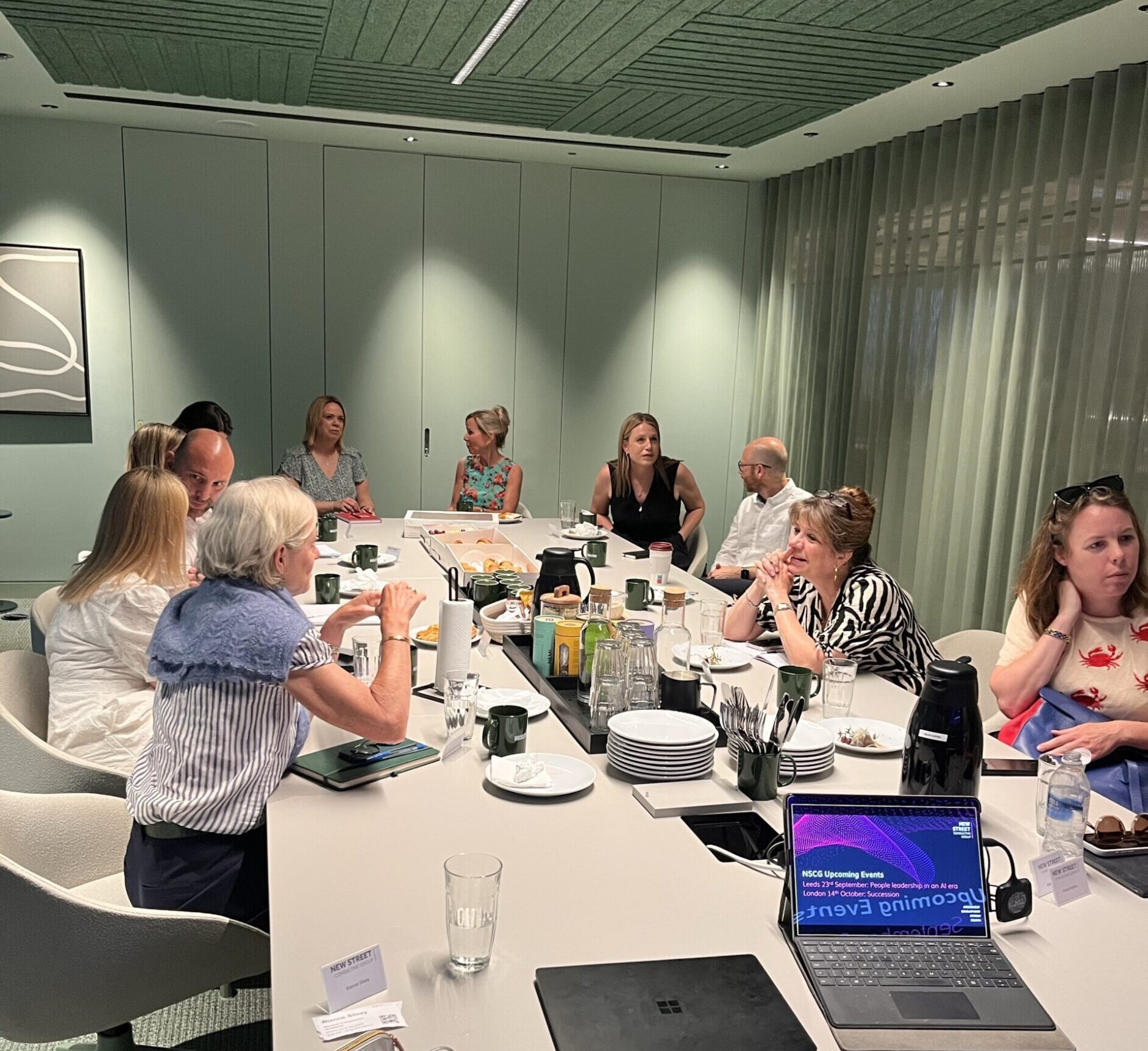
At our latest CPO Breakfast Forum, senior people leaders explored who should own the AI agenda, how performance needs to evolve in an AI-enabled workplace, and why trust may become one of the defining leadership challenges of the next decade.
What started as a discussion about ownership quickly moved to a broader question: how do organisations create the conditions for sustainable AI adoption?
AI ownership is an enterprise question
The conversation opened with a familiar debate: does AI sit with the CTO or CIO, the COO, or the CPO?
The consensus was that this is the wrong question.
- AI is not a functional initiative. It is fundamentally changing how work is organised and delivered across the business.
- Technology leaders may own the platforms and infrastructure. Operational leaders may focus on productivity and execution. The people challenge, including how work is redesigned, how skills evolve and how value is realised through people, sits across every function.
- In practice, ownership is already becoming more distributed, with HR, technology, operations, finance, risk and strategy all playing an important role.
Bottom-up adoption is moving faster than formal structures
As we have seen in previous forums, employee adoption continues to outpace organisational readiness.
- Employees are already experimenting with AI, solving problems and finding new ways to work.
- The appetite to move quickly is particularly strong within private equity-backed and fast-growing organisations, where AI is already influencing operating models and hiring decisions.
- Boards are still working through questions around governance, accountability and risk, while some are competing for a limited pool of proven AI transformation leaders.
- Most participants agreed this will be a three-to-five-year journey. Organisations will need to become comfortable with a degree of ambiguity as governance, capability and adoption develop in parallel.
Rethinking performance in an AI-enabled organisation
One of the most thought-provoking discussions centred on performance.
Many existing performance frameworks were designed around activity, output and individual contribution. They are less well suited to a world where AI is increasingly involved in how work gets done.
- If AI creates the first draft, writes the code or produces the project plan, what should organisations really assess?
- Is performance now more about judgement, creativity, decision quality and the ability to use AI effectively?
- Traditional performance management often relies on annual reviews, hindsight and manager judgement. AI creates the possibility of more real-time visibility and feedback.
- A key challenge remains how to reward exceptional contribution when AI makes high-quality output more accessible to a much wider group of employees.
AI as a tool for inclusion and development
The discussion also highlighted opportunities beyond productivity gains.
- AI has the potential to support neurodiverse colleagues by enabling different ways of working, communicating and processing information.
- AI agents could help accelerate learning and development for early-career employees, helping them build capability and confidence more quickly than traditional apprenticeship models alone.
- Organisations that view AI purely through the lens of efficiency may miss a significant opportunity to enhance learning, development and inclusion.
Building confidence, not just controls
Fear remains one of the biggest barriers to adoption.
Employees are concerned about getting it wrong, creating risk, being replaced, or being judged for using tools that many leaders are still learning to understand themselves.
The organisations making the most progress are focusing on confidence alongside governance.
- Many are building networks of AI champions across different levels and functions.
- Employees are being encouraged to identify practical use cases and develop business cases linked to real business challenges.
- This approach helps ensure adoption is driven by measurable value rather than enthusiasm alone.
Trust and the evolving employment contract
Governance and leadership cannot be separated.
The discussion centred on three important questions:
- When AI influences a decision, who remains accountable?
- How transparent should AI-enabled decision making be?
- Who is responsible for identifying and mitigating bias or unintended consequences?
Participants agreed that accountability remains with both the organisation and the individual, regardless of the role AI has played in producing an outcome.
As a result, transparency, fairness and trust are becoming increasingly important leadership capabilities.
The CPO’s role: central but not exclusive
The strongest conclusion from the session was that AI should not belong to any single function.
However, because it directly affects skills, leadership, learning, culture, inclusion, performance and trust, CPOs cannot be peripheral to the discussion.
Key questions for people leaders include:
- Which aspects of work should be redesigned and what skills will matter most?
- How should contribution be measured in an AI-enabled organisation?
- How do organisations build confidence rather than fear?
- How can productivity gains be achieved without compromising trust?
The organisations that succeed will not necessarily be those with the most advanced AI tools. They will be the ones that thoughtfully redesign work, invest in workforce capability, evolve their approach to performance, and maintain trust at the centre of the employment relationship.